 Call for Papers by NALSAR Student Law Review, Vol. XVI. Submission Deadline: 31st October 2025.
The National Academy of Legal Studies and Research (NALSAR) was established in 1998 by a Statute of the State of Andhra Pradesh. Since its inception, the University has been home to vital conversations on law and justice. With students admitted from all over the country and faculty drawn from home and abroad, NALSAR is counted amongst the top law schools of the country.
The NALSAR Student Law Review is the bi-annual, double blind, student edited and peer reviewed law review of NALSAR University of Law, Hyderabad. As the flagship publication of the University, NSLR is committed to encouraging and enhancing quality legal scholarship in India.
The NALSAR Student Law Review invites the publication of unpublished, original manuscripts on contemporary topics on the law and interdisciplinary fields for Volume XVI. Volume XVI is now open for submissions. NSLR follows a collaborative editorial process that supports authors through multiple stages of review and editing while maintaining rigorous standards of academic integrity.
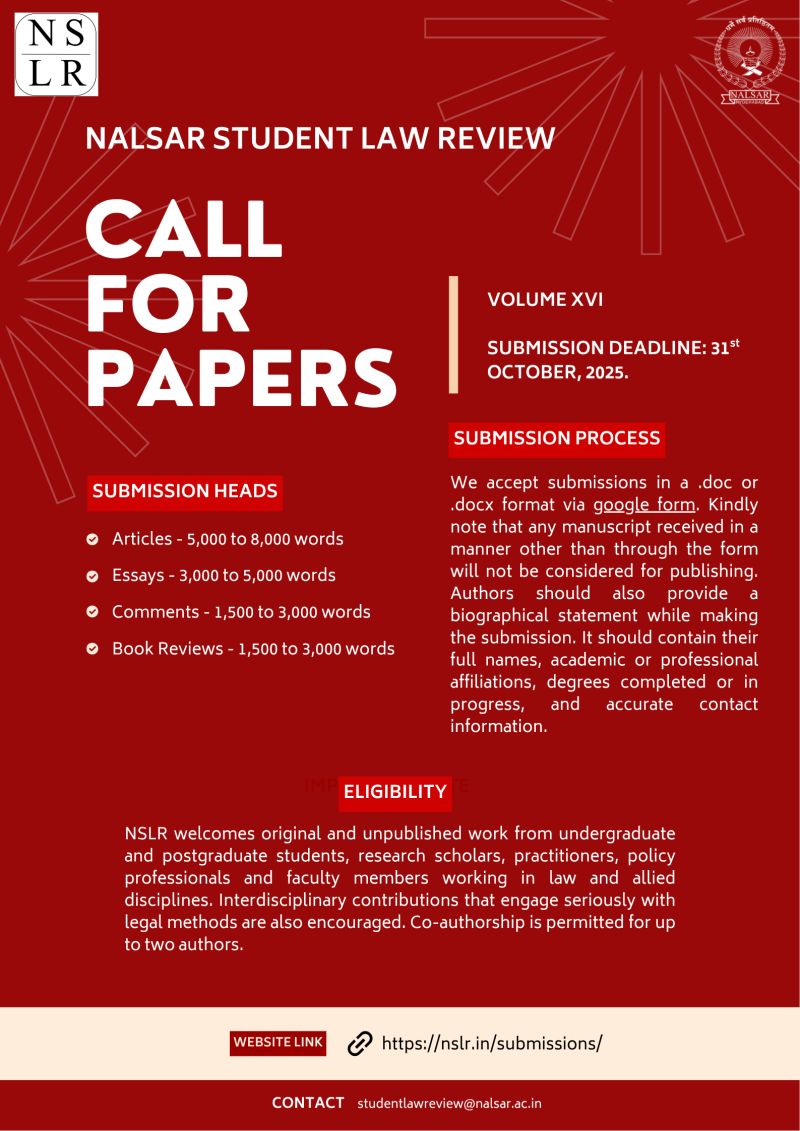
NSLR welcomes original and unpublished work from undergraduate and postgraduate students, research scholars, practitioners, policy professionals and faculty members working in law and allied disciplines. Interdisciplinary contributions that engage seriously with legal methods are also encouraged. Co-authorship is permitted for up to two authors.
Manuscripts may be submitted in the following broad categories:
All word limits are exclusive of footnotes. The Editorial Board retains discretion to relax word limits for submissions that justify additional length through depth of research and clarity of argument.
Every manuscript must include an abstract not exceeding 200 words that states the central thesis, outlines the structure of the argument and indicates the principal contribution to the literature or practice. The abstract should appear at the beginning of the manuscript
By submitting, authors confirm that their work does not infringe third party rights. All manuscripts are screened for plagiarism. Plagiarised, self plagiarised or inadequately attributed work will be rejected. The journal may request underlying data for empirical pieces and may ask for documentation to verify quotations and sources in doctrinal and theoretical work.
NSLR follows an exclusive submission policy. Submissions must be original and must not be under consideration at any other publication.
All manuscripts must comply with the following guidelines:
We accept submissions in a .doc or .docx format via google form. Kindly note that any manuscript received in a manner other than through the form will not be considered for publishing.
Authors should also provide a biographical statement while making the submission. It should contain their full names, academic or professional affiliations, degrees completed or in progress, and accurate contact information.
Kindly note that the AI declaration requested in the form must be submitted as a Word document. The declaration should state whether any AI tools were used in the preparation of the manuscript and, if so, specify the purpose for which they were used.
To ensure a fair and anonymous review process, please follow these guidelines when preparing your manuscript:
NSLR strives to conduct a fair and efficient review. Acknowledgement of receipt is generally provided within a few days of submission. The preliminary and the first editorial review typically conclude within three to four weeks from acknowledgment.
NSLR follows a structured multi-stage editorial and peer review process as outlined below:
Note: The overall process may take a few weeks where manuscripts proceed to second review and peer review. At each stage, the Author(s) may be required to make substantive, structural, or stylistic changes. All editorial decisions are made by the Board of Editors and are final. Authors are encouraged to read these policies carefully.
All queries may be directed to studentlawreview@nalsar.ac.in. Correspondence should include the manuscript title where relevant.
Any content on this website (i.e lawof.in/demo1/) is solely for information purpose. It does not constitute formal recommendation or any professional advice. Due care has been taken in posting information, the existence of omissions herein is not ruled out. Neither the author nor lawof.in accepts any liabilities for any loss or damage of any kind arising out of any inaccurate or incomplete information on this website nor for any actions taken in reliance thereon. No part of posts on this website should be distributed or copied (except for non-commercial use, personal) without express written permission of lawof.in if anyone have any query or question please mail us on lawof.in@gmail.com



© LAWOF.in | All Rights Reserved 2026.