National Conclave on Functioning of The Constitution by Dr. B.R. Ambedkar National Law University, Sonepat”. Last Date to Apply: 6th Nov 2025.
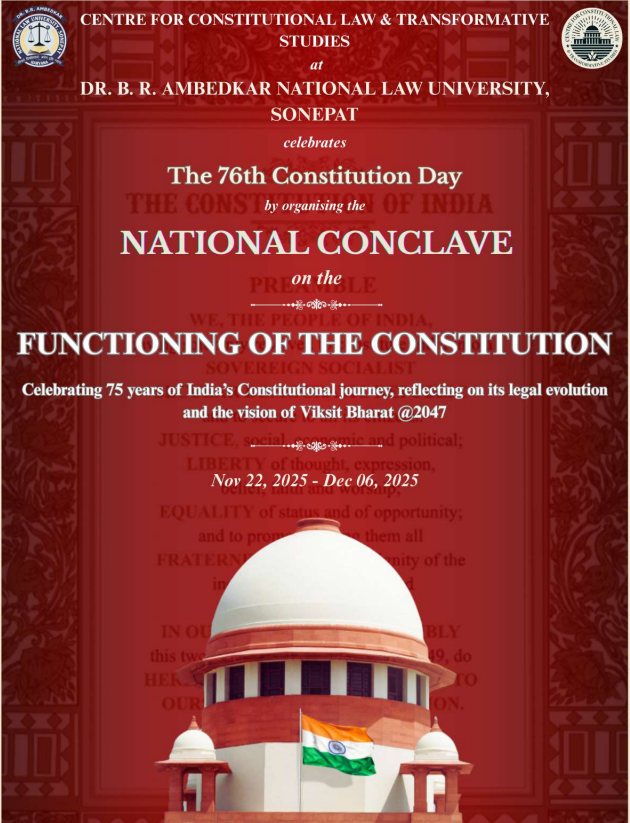
National Conclave on Functioning of The Constitution by Dr. B.R. Ambedkar National Law University, Sonepat”. Last Date to Apply: 6th Nov 2025.
About the Dr. B.R. Ambedkar National Law University, Sonepat:
Dr. B.R. Ambedkar National Law University, Sonepat, established in 2019 by the Government of Haryana, is a leading centre for legal education rooted in constitutional values and social justice. Well-connected to Delhi, it offers B.A. LL.B. (Hons.), LL.M., and Ph.D. programmes that blend academic depth with ethical and social awareness.
The University hosts eleven research centres, three specialised cells, and a Legal Aid Clinic, fostering both scholarship and community service. Its eco-friendly, inclusive campus reflects Dr. Ambedkar’s vision of law as a tool for social transformation.
Through collaborations with national and international institutions, including the V.V. Giri National Labour Institute, the Institute of Constitutional and Parliamentary Studies, and the University of Waikato, it provides students with global exposure. Under the guidance of its Chancellor, the Governor of Haryana, and the Chief Justice of India as Visitor, the University continues to advance academic excellence and prepare future legal professionals to contribute to a just and equitable society.
About Centre for Constitutional Law and Transformative Studies (CCLTS):
The Centre for Constitutional Law and Transformative Studies (CCLTS) is a dedicated research and academic hub that promotes deeper engagement with Constitutional Law among students and the wider community. It emphasizes critical inquiry and dialogue, treating the Constitution as a living document that safeguards democracy and embodies the values of liberty, equality, and fraternity. Through seminars, workshops, publications, and conferences, the Centre works to strengthen ideals of transparency, accountability, and effectiveness while nurturing legal professionals and scholars committed to constitutional morality and responsive to emerging socio‑legal challenges. In this spirit, CCLTS is organising a National Conclave on “Functioning of the Constitution: Celebrating 75 Years of India’s Constitutional Journey, Reflecting on its Legal Evolution and the Vision of Viksit Bharat @2047”, providing a platform for students, academicians, policymakers, and practitioners to deliberate on the Constitution’s evolution, functioning, and its role in shaping India’s democratic and developmental trajectory.
About the Conclave:
The National Conclave on “Functioning of the Constitution: Celebrating 75 Years of India’s Constitutional Journey and the Vision of Viksit Bharat @2047” is a 15‑day platform for dialogue on India’s constitutional legacy and future. It brings together jurists, scholars, policymakers, students, and practitioners to reflect on the Constitution’s role in governance, democracy, and socio‑economic transformation.
Designed as both an academic forum and a constitutional festival, the Conclave features panel discussions, paper presentations, a National Youth Parliament, quiz and advocacy competitions, and other interactive events. Key themes include fundamental rights, judicial accountability, institutional coordination, and constitutional morality, with discussions extending to social justice, sustainability, governance, and economic reform.
By incorporating student initiatives, research exhibits, and global comparative perspectives, the Conclave positions itself as more than a commemorative event—an intellectual movement envisioning a just, inclusive, and developed India aligned with the vision of Viksit Bharat @2047.
List of Events:
National Conference on Functioning of the Constitution “Celebrating 75 years of India’s Constitutional journey, reflecting on its legal evolution and the vision of Viksit Bharat @2047”
Panel Discussions on Constitutional Governance
National Youth Parliament
Constitutional Law Quiz Competition
Constitutional Hackathon
Interactive session for reimagining constitutional provisions for Viksit Bharat @2047
Policy Drafting Competition
Judgment Writing Competition
Legal Essay Writing Contest
Scholarly Dialogue focusing on Constitutional cases and current issues
Open Forums on Emerging Trends
Asian Parliamentary Debate Competition
National Conference Details:
SUB-THEMES
Safeguarding Constitutional Morality: The Basic Structure Doctrine in Contemporary India.
Fundamental Rights in the Digital Age: Constitutional Responses to Emerging Technologies
Constitutional Innovations and the Pursuit of Gender Justice
Comparative and Transnational Influences on India’s Constitutional Jurisprudence
Constitutional Amendments: Engines of Change in India’s Legal and Social Order
Systemic Challenges and Pathways to Strengthening Access to Justice
Constitutional Craftsmanship: Shaping Transformative Legal and Social Change
Separation of Powers and Rule of Law
Economic Governance and the Institutional Roles Constitution: Evolving Judicial and
Balancing Judicial Activism and Restraint in Constitutional Governance
Reforms in Appointments and Accountability: The Collegium System and Beyond
Empowering Marginalised Groups and Children: Constitutional Rights and Effective Remedies
Advancing Intersectional and Inclusive Rights under the Indian Constitution
Environmental Protection and Sustainable Development: Duties and Judicial Innovations
Constitutional Amendments and Judicial Transformation
GUIDELINES FOR SUBMISSION:
An abstract should be submitted in .docx and .pdf formats. Abstracts will be peer reviewed before they are accepted. The selection of papers for presentation will be based on abstracts. An abstract must include a clear indication of the purpose of the research, methodology, major results, implications and key references. The following information, in the given format, should be sent along with the abstract. The full paper must be accompanied by a brief profile of the author, including the author’s name, university/organisation/institution, and email ID.
Abstracts and Full Papers shall be accepted on a Rolling Basis.
Word limit of the Abstract: 250-300 words.
Word limit of the Full Paper: 3000-5000 (excluding footnotes)
The main text should be in Times New Roman with font size 12 and line spacing of 1.5.
The footnotes should be in Times New Roman, font size 10, with single line spacing.
One-inch margins on all sides should be maintained.
Citation Style: Bluebook 21st Edition/ APА
Submission topics to be limited to the provided sub-themes, and must adhere to only one of them. No author may make more than one entry.
Co-authorship of up to two authors is permitted. All submissions must be the author’s original and unpublished work. Plagiarised submissions will be disqualified. In case of any disputes, the decision of the Organising Committee shall be final and binding.
Selected papers will be published in the conference proceedings; however, additional charges will apply for publication.
The Conference will be conducted in hybrid mode.
There shall be a zero-tolerance policy on plagiarism, and copyright similarity up to 10% is permissible. All final submissions will be subjected to blind peer review and a plagiarism check, after which the selected papers will be considered.
Any content on this website (i.e lawof.in/demo1/) is solely for information purpose. It does not constitute formal recommendation or any professional advice. Due care has been taken in posting information, the existence of omissions herein is not ruled out. Neither the author nor lawof.in accepts any liabilities for any loss or damage of any kind arising out of any inaccurate or incomplete information on this website nor for any actions taken in reliance thereon. No part of posts on this website should be distributed or copied (except for non-commercial use, personal) without express written permission of lawof.in if anyone have any query or question please mail us on lawof.in@gmail.com
 National Conclave on Functioning of The Constitution by Dr. B.R. Ambedkar National Law University, Sonepat”. Last Date to Apply: 6th Nov 2025.