Moot Court Competition | Surana & Surana | School of Law | Raffles University | Labour Law | Register by 22nd October 2026
Moot Court Competition | Surana & Surana | School of Law | Raffles University | Labour Law | Register by 22nd October 2026
9thSurana & Surana and School of Law, Raffles University
Labour Law Moot Court Competition, 2026 – 2027
(13th– 15thNovember, 2026)
About Raffles University
Raffles University Neemrana, established by an Act of Rajasthan State Legislature, as per Section 2(f) of UGC Act 1956, is a multi-disciplinary University providing world class education through its various schools namely:
Raffles Law School
Alabbar School of Management
School of Engineering & Technology
School of Basic & Applied Sciences
School of Agricultural Sciences
School of Pharmacy
School of Humanities & Social Sciences
Raffles University situated in NCR at Neemrana, on Delhi-Jaipur National Highway No. 48, is just 90 Kms away from Delhi International Airport and is also connected by a six-lane express way and by railway line at Rewari Junction. The distance from Jaipur is 140 Kms.
The state-of-the-art infrastructure with all modern facilities, built on a sprawling 50 Acres of land, is set in an unpolluted serene environment in the lap of Aravali hills. The University is based on GURUKULA concept whereby the students move away from the rough and tumble of stressful existence to the quieter environ of the University in Neemrana. This ambience, enables a strong bond between teacher and pupil ensuring thereby greater attention to instruction as well as education free of distraction and impediments. And yet, it is not as if the Gurukul is insular in nature. Students are encouraged to explore and expand the frontiers of their knowledge through broad Internet and interactions.
Raffles University provides an environment for open discussion between the faculty and students which is designed to ignite the urge to explore and learn beyond boundaries. The confluence of minds and cultures from all over the world provides the ambience for shaping students into global citizens and leaders.Diversity and flexibility of options of courses to choose from, is aimed at enabling students to pursue studies most suited to their intellect and talent. This enables the students to discover, nurture and expand their individual talents, skills and interests so that they emerge as leaders and path breakers wherever they go.
About the Competition
The Surana & Surana and School of Law, Raffles University, Labour Law Moot Court Competition is a premier national moot court competition, jointly organized by School of Law, Raffles University and Surana & Surana International Attorneys, Chennai, dedicated to promoting excellence in legal education, advocacy, and research in the evolving field of Labour and Employment Law. The competition serves as a unique platform for aspiring legal professionals to engage with contemporary legal challenges at the intersection of Labour Law, Employment Law, Constitutional Law, Administrative Law, Service Law, and other allied disciplines.
Through this collaboration, the organizers seek to provide an intellectually stimulating platform that encourages rigorous legal research, persuasive advocacy, and critical engagement with contemporary issues in labour law. The competition aspires to nurture the next generation of legal professionals by fostering academic excellence, professional ethics, and innovative legal thinking in one of the most dynamic and rapidly evolving areas of law.
MOOT PROPOSITION
Aarohi Sen & Others
Vs.
NeuroPulse Technologies Pvt. Ltd. & Union of Aaryavrat
The Republic of Aaryavrat is a federal democratic republic committed to the ideals of constitutional governance, social justice, economic development and the rule of law. In recent years, the Government has actively promoted digital innovation and artificial intelligence as key drivers of economic growth. Simultaneously, rapid technological advancements have raised important concerns regarding the protection of individual rights within employment relationships, particularly where automated systems increasingly influence workplace management and decision making.
NeuroPulse Technologies Pvt. Ltd. (“NeuroPulse”) is one of Aaryavrat’s leading technology companies engaged in providing artificial intelligence, cloud computing and cybersecurity solutions to domestic and international clients. Employing over 12,000 persons across multiple establishments, the Company follows a hybrid working model and has consistently projected itself as an organisation committed to technological innovation, employee welfare and responsible corporate governance.
During late 2024, NeuroPulse experienced repeated cyber intrusion attempts targeting confidential client information. Although no major breach occurred, increasing contractual obligations, operational challenges associated with hybrid work and growing employee attrition prompted the Company’s Board of Directors to approve the deployment of an artificial intelligence-based workplace management system intended to strengthen cybersecurity while improving workforce efficiency and resource allocation.
Accordingly, on 1 January 2025, NeuroPulse introduced an AI-enabled workplace monitoring and workforce management platform known as OptiWork 360. The system was designed to analyse various categories of digital workplace activity, generate automated engagement assessments and provide predictive insights to managerial personnel for operational planning. According to the Company, the system functioned as a decision-support mechanism and was not intended to replace independent managerial judgment in employment-related decisions.
Before implementation, NeuroPulse circulated a revised Employee Analytics and Security Policy informing employees that specified categories of workplace data would be processed for purposes including cybersecurity, regulatory compliance, productivity assessment and resource planning. Employees were required to acknowledge the policy electronically as a condition of continued access to the Company’s digital infrastructure. While the Company maintained that the AI system operated subject to human oversight, it declined to disclose the underlying algorithm or its training methodology, asserting that such information constituted commercially sensitive intellectual property.
For the initial months following its implementation, the AI system was largely accepted by employees. However, concerns gradually emerged regarding the methodology used to generate engagement assessments and the extent to which such assessments influenced managerial decisions. Several employees reported fluctuations in their performance ratings without receiving any explanation of the factors considered by the system.
Among those expressing concern was Ms. Aarohi Sen, President of the NeuroPulse Employees’ Association, a registered trade union representing employees across the Company’s establishments. The Association, which had previously maintained a cooperative relationship with the management, received representations from employees questioning the transparency, fairness and accountability of the AI system. While acknowledging the Company’s legitimate interest in ensuring cybersecurity and operational efficiency, the Association sought greater clarity regarding the use of automated assessments in employment-related decisions.
The Employees’ Association submitted a formal representation requesting, inter alia, disclosure of the broad parameters governing the AI system, an independent assessment of its functioning and safeguards to ensure that automated outputs did not disproportionately affect any category of employees. Particular concerns were expressed regarding employees returning from maternity leave and certain employees with disabilities, who allegedly experienced unexplained declines in engagement assessments following the implementation of the system. The Association further apprehended that extensive workplace monitoring could discourage employees from freely participating in lawful trade union activities. NeuroPulse denied these allegations and maintained that the system neither discriminated against any employee nor monitored protected labour activities.
In response, NeuroPulse reiterated that the AI system functioned solely as an assistive analytical tool and that all employment-related decisions continued to be taken by designated managerial personnel after considering multiple factors. The Company refused to disclose the algorithm, source code or training datasets, contending that such information constituted proprietary intellectual property and that disclosure could compromise the integrity and security of the system. It nevertheless assured employees that periodic internal reviews were undertaken to identify and address any unintended bias in the system’s functioning.
On 17 July 2025, an anonymous electronic communication was circulated to several media organisations, regulatory authorities and employee representatives. The communication alleged that internal documents suggested the AI system generated predictive assessments concerning employee retention, performance and workplace engagement, and that such outputs could influence decisions relating to promotions, assignments and workforce restructuring. It further questioned whether the system had a disproportionate impact upon certain categories of employees. The identity of the sender remained unknown, and the authenticity of the allegations became a matter of public controversy.
The publication of the anonymous communication attracted significant media attention and intensified public debate concerning the regulation of artificial intelligence in employment. NeuroPulse initiated an internal inquiry after concluding that confidential corporate information had been unlawfully disclosed. During the course of the inquiry, Ms. Aarohi Sen and certain other office-bearers of the Employees’ Association denied any involvement in the disclosure but criticised the disciplinary proceedings as retaliatory and intended to suppress legitimate employee concerns. The Company, on the other hand, maintained that the proceedings were directed solely towards investigating serious acts of misconduct involving breach of confidentiality.
Following the completion of the disciplinary proceedings, NeuroPulse terminated the services of Ms. Aarohi Sen and certain other office-bearers of the Employees’ Association on 30 July 2025, citing grave misconduct and loss of confidence. The Employees’ Association challenged the action as arbitrary, disproportionate and violative of labour rights, asserting that the dismissals were a consequence of their persistent demands for greater transparency in the use of artificial intelligence. The Company categorically denied these allegations and maintained that the dismissals were based exclusively on the findings of the disciplinary inquiry.
The dismissal of the Association’s office-bearers triggered widespread unrest across NeuroPulse establishments. On 31 July 2025, employees across several offices collectively refrained from logging into the Company’s digital systems for one working day while remaining available for dialogue with the management. The Employees’ Association described the action as a peaceful protest against AI enabled workplace surveillance, alleged algorithmic opacity and the dismissal of its elected representatives. NeuroPulse, however, characterised the coordinated action as an unlawful disruption of essential business operations that adversely affected its contractual commitments and commercial interests.
The dispute soon attracted nationwide attention, prompting extensive debate regarding the regulation of artificial intelligence in employment. While industry bodies emphasised the need to preserve innovation, cybersecurity and the confidentiality of proprietary technologies, labour organisations demanded greater transparency, accountability and safeguards against automated decision-making affecting employees. Against this backdrop, the Government of Aaryavrat, on 12 August 2025, issued the Strategic Digital Enterprises (Workplace Security and Monitoring) Guidelines, 2025, recognising the legitimate use of workplace monitoring technologies while emphasising proportionality, transparency, meaningful human oversight and respect for employees’ lawful labour rights. The Guidelines, however, did not mandate disclosure of proprietary algorithms or source codes.
In view of the continuing controversy, the National Labour Commission appointed Dr. Ishan Verma, an independent expert in artificial intelligence and data governance, to undertake a preliminary assessment of the AI system. Having examined anonymised employee data, policy documents and representations submitted by the parties, Dr. Verma submitted his report on 11 September 2025. The report observed that the available material suggested a statistically disproportionate impact upon certain categories of employees, including some employees returning from maternity leave and certain employees with disabilities, and that AI-generated assessments may have been considered in decisions relating to assignments, promotions and workforce planning. At the same time, the report expressly stated that no conclusive findings regarding discrimination or interference with trade union activities could be reached in the absence of access to the proprietary algorithm, source code and training datasets. NeuroPulse questioned the report’s evidentiary value, whereas the Employees’ Association relied upon it in support of its grievances.
Meanwhile, the Employees’ Association raised an industrial dispute challenging the dismissals and alleging unlawful workplace surveillance, victimisation of trade union office-bearers and unfair employment practices. Conciliation proceedings initiated under the applicable labour laws failed to produce a settlement. Consequently, the Appropriate Government referred the industrial dispute to the National Industrial Tribunal.
Simultaneously, the Employees’ Association, certain affected employees and public interest organisations instituted proceedings before different High Courts questioning the legality of the AI-based monitoring system and the constitutional validity of the Strategic Digital Enterprises (Workplace Security and Monitoring) Guidelines, 2025. NeuroPulse and the Union of Aaryavrat contested the maintainability and merits of these challenges, asserting that the Company’s practices and the Government’s regulatory framework were lawful, proportionate and consistent with constitutional and labour law principles.
As similar questions involving artificial intelligence, workplace surveillance, labour rights and constitutional governance came to be considered by different High Courts, divergent interim orders were passed concerning the operation of AI enabled workplace monitoring systems and the rights and obligations of employers and employees in strategic digital enterprises. Considering the substantial questions of constitutional importance involved and their potential ramifications for employment relations across the Republic, the Supreme Court of Aaryavrat transferred all connected proceedings to itself and directed that the industrial reference and the constitutional challenges be heard together by a Constitution Bench. The matters are now listed for final hearing before the Supreme Court of Aaryavrat.
ISSUES FOR ADJUDICATION:
Whether the deployment and use of OptiWork 360 by NeuroPulse Technologies Pvt. Ltd. are legally sustainable in light of employees’ rights to privacy, dignity and informational autonomy?
Whether the use of algorithmic profiling and automated decision-making allegedly resulting in a disproportionate disadvantage to employees returning from maternity leave and employees with disabilities amounts to discrimination and an unfair labour practice, and the extent to which the findings of Dr. Ishan Verma’s report may be relied upon in determining such allegations?
Whether the collection, processing and use of employee data through AI-enabled workplace management unlawfully interfered with employees’ freedom of association, participation in trade union activities and other protected labour activities?
Whether the disciplinary proceedings and consequent dismissal of Ms. Aarohi Sen and the other office-bearers of the NeuroPulse Employees’ Association are legally sustainable, and whether the deployment and use of OptiWork 360 in relation to them, together with the disciplinary action taken against them, constitute discrimination, victimisation, or an unfair labour practice?
Whether the Strategic Digital Enterprises (Workplace Security and Monitoring) Guidelines, 2025 have the requisite legal authority and validity to regulate the implementation and deployment of AI-based workplace monitoring systems and govern the jural relationship between employers and employees?
Nota Bene:
All facts mentioned and the references made are fictional.
The laws of the Republic of Aaryavrat are pari materia with the law of Republic of India.
Issues and sub-issues can be added and modified provided they do not alter the fundamental premise
RULES AND REGULATIONS
ELIGIBILITY & TEAM COMPOSITION
The competition is open for bonafide students pursuing 5 Years and 3 Years Law programs in India.
Each College/University/Institution shall be allowed to register only one team in the competition.
Each team should consist of a minimum of 2 and maximum of 3 members. This number cannot be modified under any circumstances.
There shall be 2 speakers and 1 researcher designated for each team. The researcher shall be allowed to argue with prior permission of the court and Chief Administrator in case of illness of the designated speakers.
Each team will be provided a team code prior to the submission of memorials via e-mail. This team code is only for the submission of memorials. Teams should not disclose the identity of their institution in their memorials; such disclosure shall invite penalties including disqualification. The decision for the same shall be at the discretion of the Chief Administrator.
REGISTRATION
Online registrations will be open from 1 September, 2026. The teams must register online by 22 October, 2026. Teams will have to register online at www.moot.in. In total, 30 teams will be registered to participate in the competition on a first- come-first serve basis.
No temporary registration requests will be entertained. Kindly refrain from sending such requests to Surana & Surana or School of Law, Raffles University, Neemrana
Participants will receive an automated system generated acknowledgement on successful submission of registration. Participants will receive an approval as acceptance of their request for participation by 23 October, 2026 or earlier.
Registration Process:
The Registration form cum approval letter as provided in the rules duly signed & sealed by your university / college / moot society.
Upload both (i) & (ii) together as a single PDF:
The Registration form cum Approval letter (without seal & signature) as provided in the rules duly filled along with
Scanned copy of authorisation letter with sign and seal from your university / college / moot society.
OR
An email communication from the official id (to be filled as notification email id during online registration process) of the institution, from your university / college / moot society to complete the registration process.
Note:
Signatories on the registration form should be any of the following: – Faculty in-charge of MCA / MCS / MCC, Registrar, Dean, Principal, Director, Chancellor or Vice-Chancellor.
Registration without the scanned copy of the approval letter / an email communication from the college/institution/university or duly attested registration form will not be valid.
Soft copy of the registration and approval letter/ an email communication as a single PDF to be sent by email to th ai@lawindia.com & copy to mcc@rafflesuniversity.edu.in marked as 9 Surana & Surana and School of Law, Raffles University, Labour Law Moot Court Competition, 2026-27 Registration as subject of the mail latest by 22 October, 2026. The provisional team code shall be allotted to the registered teams by Host University soon after receiving of registration particulars. The Provisional team code is to be used for submission of only the soft copies of your memorials.
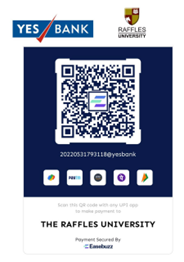
A registration fee of Rs. 2,000/- is to be paid by way of Online Money Transfer / UPI / Paytm / Google Pay in favour of Raffles University.
Payment through UPI QR code.
Payment Details are as follows
Account Number- 013194600000300
Beneficiary Name- Raffles University IFSC Code- YESB0000131
Bank Name- YES Bank, Neemrana, Alwar, Rajasthan
Details- Student’s Name and College/Institution Name.
The payment reference number and date of payment must be mentioned and a scanned copy of the payment receipt also has to be attached and sent to mcc@rafflesuniversity.edu.in. Only then will the registration be deemed to be complete for rounds.
In the event a team drops out of the competition or is disqualified, the team next in line as per registration data (When the registration exceeds beyond the permitted 30 teams) will be offered the chance to participate in the competition at short notice. Such teams will have to submit memorials to be eligible at least 3 days prior to the start of the competition
AWARDS (Prizes)
Rs. 21,000/- Cash Prize for the Winner.
Rs. 11,000/- Cash Prize for the Runner up.
Rs. 5,100/- Cash Prize for the Best Student Advocate.
Rs. 5,100/- Cash Prize for the Best Memorial.
Clarifications on the moot proposition may be sought before 15 October, 2026 with an email toai@lawindia.com & copy to themcc@rafflesuniversity.edu.in
Any content on this website (i.e lawof.in) is solely for information purpose. It does not constitute formal recommendation or any professional advice. Due care has been taken in posting information, the existence of omissions herein is not ruled out. Neither the author nor lawof.in accepts any liabilities for any loss or damage of any kind arising out of any inaccurate or incomplete information on this website nor for any actions taken in reliance thereon. No part of posts on this website should be distributed or copied (except for non-commercial use, personal) without express written permission of lawof.in if there is any question or query then please mail on lawof.in@gmail.com
 Moot Court Competition | Surana & Surana | School of Law | Raffles University | Labour Law | Register by 22nd October 2026